- Industry
- E-commerce · DTC · matcha
- Scope
- Subscriptions, retention flows, product page A/B tests, personalisation, AI support agent
- Stack
- Shopify · Recharge · Klaviyo · Dynamic Yield · Claude
- Results measured over
- 6 months
Results
Who is the client and what do they sell?
matchanhype.com is a DTC brand selling matcha straight to consumers. Matcha runs out and people buy it regularly once it becomes a habit — a perfect candidate for a subscription model.
The brand converted first-time buyers well. The problem started after that: too few customers came back for the next pack.
What was the problem with one-time sales?
One-time sales had high conversion but low LTV: customers bought once and disappeared. We had to build a subscription model without killing one-time conversion — in other words, add a new path without breaking the one that already worked.
Why is that hard? Pushing subscriptions aggressively on the product page can put off people who just want to try the product. And a subscription with no post-purchase care quickly ends in cancellation. The brand needed a full lifecycle, not a single “subscribe” button.
What were the project goals?
The goal was to raise LTV through a subscription model with personalisation and retention sequences — from acquisition to win-back — while keeping one-time conversion where it was. On top of that, we wanted to take load off customer support, which gets more questions as the subscriber base grows.
- Higher LTV and 90-day retention.
- As large a share of customers on subscription as possible.
- No cannibalisation of one-time sales.
- Automated handling of repetitive support tickets.
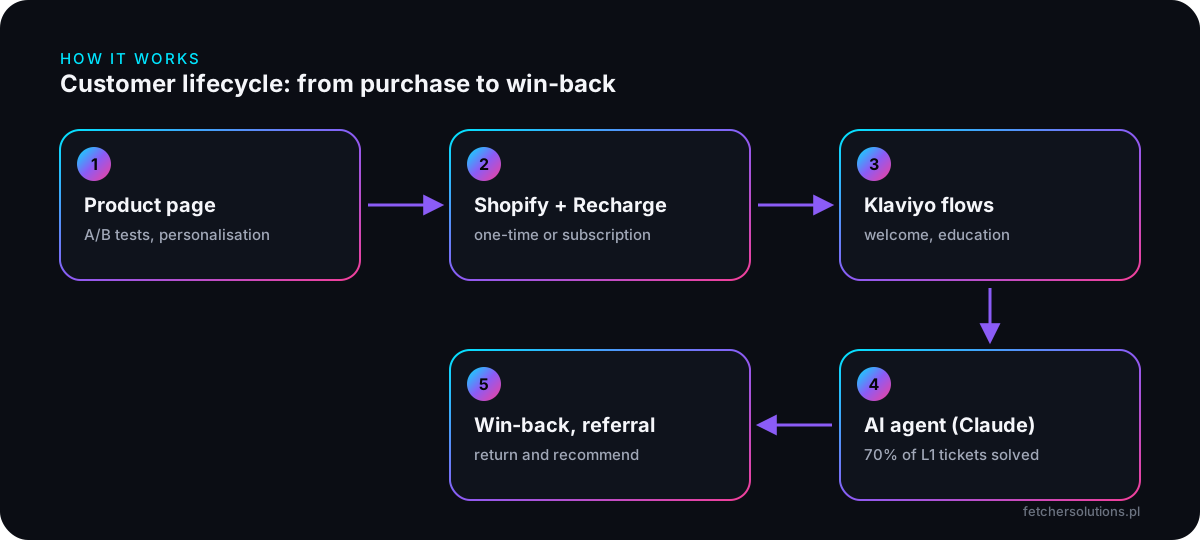
How did we build the DTC lifecycle, step by step?
The solution combines five parts: Shopify subscriptions via Recharge, Klaviyo flows, product page A/B tests in Dynamic Yield, personalised recommendations and a Claude AI support agent. Together they cover the entire customer lifecycle — from first visit to win-back.
1. Subscriptions: Shopify + Recharge
Flexible delivery frequency, pausing and product swaps. This matters: a customer who can easily pause a delivery or switch flavours is less likely to cancel altogether.
2. Klaviyo flows
Four sequences: welcome, post-purchase education, winback and referral. Post-purchase education shows how to prepare matcha and fit it into daily life — building the habit a subscription relies on. Winback recovers people who dropped off, and referral turns happy customers into an acquisition channel.
3. Product page A/B testing
We ran 12 experiments in 6 months on the product page using Dynamic Yield. Instead of guessing how to present the subscription option next to a one-time purchase, we tested it on real traffic.
4. Personalisation
Recommendations based on customer history — Shopify ML plus custom logic tailored to the brand's range.
5. AI support agent (Claude)
An agent built on Claude automatically resolves 70% of L1 tickets — the repetitive first-line questions. The team focuses on cases that genuinely need a human.
Why this tech stack?
Each tool owns one stage of the lifecycle and is a standard in its category: Shopify and Recharge for sales and subscriptions, Klaviyo for messaging, Dynamic Yield for experiments and Claude for customer support. The brand doesn't maintain fragile custom code where mature solutions already exist.
- Recharge — subscriptions with pausing and product swaps, without building billing from scratch.
- Klaviyo — flows triggered by customer behaviour rather than manually sent campaigns.
- Dynamic Yield — product page experiments without re-deploying every variant.
- Claude — a language model that handles natural conversation well. Learn more on our AI chatbots page and in 10 processes you'll automate with AI agents.
What did the subscription model deliver?
After 6 months LTV was 2.4× the baseline, 38% of customers were on subscription, 90-day retention was up 52% and the conversion rate stayed stable — subscriptions did not cannibalise one-time sales.
| Metric | Result after 6 months |
|---|---|
| LTV | 2.4× vs. baseline |
| Subscription share | 38% of customers |
| 90-day retention | +52% |
| Conversion rate | stable |
| L1 tickets | 70% resolved by AI |
The stable conversion rate is the key line. It means the LTV growth is pure upside — the brand didn't pay for subscriptions by losing new customers.
How did the collaboration work?
We followed our FETCH framework: Focus → Explore → Transpose → Commit → Handoff. A 30-minute call about LTV, churn and the customer journey, then a technical brief with a fixed-price quote, then two-week sprints with demos and a feedback loop under 24 hours.
In a subscription project, order matters. The subscription mechanism and customer self-service have to work first; only then does retention messaging that drives people into it make sense. Product page experiments and personalisation are a layer you tune over time — hence 12 tests spread over 6 months rather than one big redesign.
The AI support agent has a clearly bounded role: it answers typical first-line (L1) questions, and anything beyond that stays with people. Every launch comes with a 30-day warranty, with ongoing support available through a Care plan.
Who is a similar project right for?
This makes sense for DTC brands with a consumable product — coffee, tea, supplements, cosmetics — that convert first purchases well but see weak repeat rates. If customers buy once and vanish, a lifecycle with subscriptions and retention is the simplest LTV lever.
Scope and pricing are on our Shopify development page.
Let's build your DTC lifecycle.
A 30-minute call about your LTV, churn and retention potential.
Book a free consultation →Frequently asked questions
Will subscriptions reduce one-time sales?
They don't have to. At matchanhype.com the conversion rate stayed stable while 38% of customers moved to subscriptions. The key was product page A/B testing (12 experiments in 6 months) to find how to present both options side by side.
How much does a Shopify store with subscriptions cost?
Shopify stores start from €1,850, a store with a custom theme is €3,500 in our calculator, and an AI chatbot starts from €820. You get an exact fixed-price quote within 48 hours of a free discovery call.
How many tickets can an AI support agent take over?
In this project the Claude-based agent automatically resolves 70% of L1 tickets. Unusual cases still go to people, so the team focuses on the harder ones.
Which Klaviyo flows should a DTC store have?
At matchanhype.com we set up four: welcome, post-purchase education, winback and referral. Together they cover the lifecycle from the first purchase through habit-building to winning customers back and generating referrals.