TL;DR
- Business site (5 pages) from €1,150, shipped in 7–14 days
- Company site with blog from €3,000; larger CMS sites from €3,500 in 3–6 weeks
- Built on Next.js or Astro with a headless CMS; CWV 90+ as standard
- Restaurant site we built: +240% online bookings and #1 for its main local keyword
What makes a business website modern in 2026?
A modern business website loads almost instantly, reads well on a phone, ranks in Google and is structured so AI search engines can quote it. It also converts: clear offers, visible prices or next steps, and forms that connect to your calendar or CRM. Looks matter, but speed, structure and conversion are what earn the investment back.
Every FETCHER website includes, as standard:
- Core Web Vitals in the green – our Starter sites target a score of 90+.
- On-page SEO – titles, headings, internal links and clean URLs.
- Schema.org structured data describing your business, services and FAQs.
- GEO-ready content – direct answers and clear facts that AI assistants can cite.
- Forms that do something – booking via Google Calendar, leads into your CRM.
We describe the result as fast as an app, readable as an editorial and sales-ready as a landing page.
Next.js, Astro, Webflow or WordPress – which should you choose?
For most business sites we recommend Next.js or Astro with a headless CMS: they are fast, secure and cheap to host. Webflow or Framer suit teams that want visual editing above all. We pick the platform for your needs and team, and explain the trade-offs before you commit, rather than forcing one stack on every client.
| Platform | Choose it when |
|---|---|
| Astro | Content-led sites and landing pages where speed is the priority |
| Next.js | Sites with dynamic features: bookings, client areas, integrations |
| Webflow / Framer | Marketing teams who want to design and publish visually |
| Headless CMS | Editors need to update content without touching code |
As an example of what lean code can do, a fintech SaaS landing page we built in Astro reached an LCP of 0.9 seconds while running a three-way A/B test.
Whichever platform we choose, the code follows current standards, is documented, and sits in your repository. That makes the site easy to extend later – a new language, a booking module, a client area – without starting again from scratch.
How long does it take to build a business website?
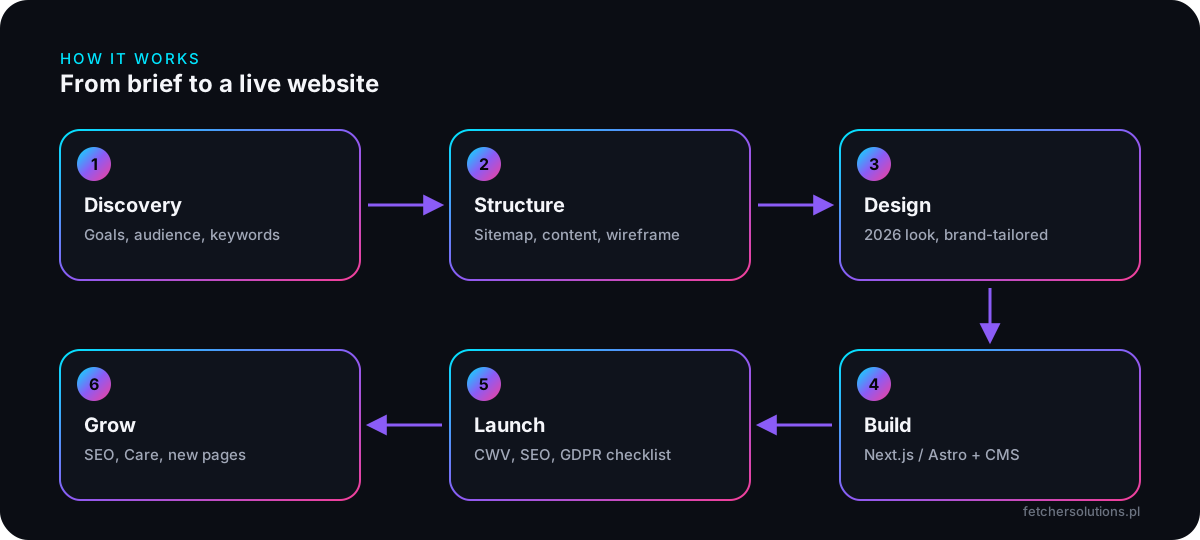
A five-page business website ships in 7–14 days. A content-rich company site with a CMS, blog and integrations takes 3–6 weeks. The timeline is fixed in the written brief you receive within 48 hours of our discovery call, and you can follow daily progress in Notion throughout the build.
The process follows our FETCH framework:
- Focus – a free 30-minute call on goals, audience, competitors and budget.
- Explore – sitemap, technical brief, schedule and a fixed price within 48 hours.
- Transpose – design and build in two-week sprints, with a demo after each and feedback within 24 hours.
- Commit – launch checklist covering Core Web Vitals, SEO and GDPR, plus a 30-day warranty.
- Handoff – CMS training, documentation, repository and all access.
The biggest risk to any website timeline is content arriving late, so we agree early who writes what and when. We also confirm decision-makers on your side: one person who can approve designs and copy keeps the project moving, while feedback from a committee of six tends to add weeks.
What can a well-built website do for a local business?
For sushisoul.pl, a sushi restaurant in Łódź competing with 40+ others, we built a Next.js site with online table reservations, a CMS-managed menu and full local SEO. Within four months it ranked #1 in Google for its main local keyword, reached the top 3 in Google Maps, and online reservations grew 240%.
Before the project the restaurant sat at position 15+ in Google Maps, with an outdated site, no online booking and an incomplete Google Business Profile. The new setup:
- Static Next.js pages with incremental regeneration for the menu.
- A reservation system with a table calendar, SMS confirmations and POS integration.
- Menu editing in Sanity CMS, so staff update prices without a developer.
- A complete Google Business Profile, LocalBusiness and Restaurant Schema, and 50+ photos.
- Automated SMS after each visit inviting guests to leave a Google review.
The average rating rose from 4.3 across 40 reviews to 4.8 across 180+. Read the sushisoul case study.
Will the website be ready for Google and AI search?
Yes. SEO and GEO are part of the build, not an add-on. Each page gets a clear heading structure, descriptive titles, internal links and Schema.org markup, and the content is written so that both Google and AI assistants such as ChatGPT, Perplexity and Claude can extract and cite direct answers about your business.
Technical foundations we take care of at launch:
- XML sitemap and robots rules, submitted to Google Search Console.
- 301 redirects from old URLs if you are replacing an existing site.
- Hreflang and localised metadata for multilingual sites.
- GA4 and Search Console so you can measure traffic and conversions from day one.
To grow rankings after launch, our SEO and GEO service adds content, links and ongoing optimisation. The Growth package already includes a three-month SEO campaign.
Can a website do more than present your company?
Yes, and the best ones do. A website can take bookings and deposits, qualify leads, show customers their orders, or let wholesale buyers order online. Once it connects to your calendar, CRM or ERP, it stops being a brochure and starts removing work from your team. We build those features in Next.js on the same codebase as the site.
Examples of functionality we have shipped on top of business websites:
- Reservations – table or appointment calendars with SMS confirmations and reminders.
- Deposits and payments – online prepayments through Stripe or local payment gateways.
- Client areas – logged-in portals with order history, documents and invoices.
- Lead routing – form submissions sent straight to the right person in your CRM, with an automatic follow-up.
The far end of that spectrum is a full B2B ordering portal. For a wholesale distributor with 400+ business customers we built a Next.js portal connected to their ERP; four months after launch 85% of orders came through it. See the B2B portal case study.
When a feature needs to talk to several back-office systems, we scope it together with our system integration team so the data flow is designed once, properly.
Can you build a multilingual website for several EU markets?
Yes. We build sites in English, German and Polish with correct hreflang tags, localised Schema and Open Graph data, so each language version ranks in its own market. Translating an existing site into another of those languages starts at €190. The structure is planned up front, so adding a market later does not mean rebuilding.
Our clients include companies in Germany, the UK, the Netherlands, Austria and the Czech Republic, and the whole project runs remotely on Google Meet, Slack and Notion. You get a single point of contact, a written timeline and replies within 4 hours during CET business hours.
Moving domains as part of the project? Domain and DNS migration with SSL and 301 redirects starts at €70.
Who hosts and owns the website after launch?
You do. By default the site lives on your own hosting account – we recommend Vercel or Netlify for Next.js and Astro – and the code sits in a GitHub repository you own. At handoff you receive every password, the repository and documentation. Nothing is vendor-locked, so you can switch developers whenever you like.
Hosting a modern static or hybrid site is typically inexpensive and needs little maintenance, but websites still need care: security updates, monitoring, small content changes and new landing pages for campaigns. Every project includes a 30-day warranty covering bugs not caused by later changes on your side. After that, Care plans start at €160/mo with uptime monitoring, security patches and dev hours, and a single campaign landing page starts at €280.
How much does a business website cost?
A five-page business website starts at €1,150 and ships in 14 days. A company website with a blog starts at €3,000, and larger content-rich sites start at €3,500. A single campaign landing page starts at €280. Every project is quoted at a fixed price after a free 30-minute call, and the price does not move afterwards.
| Scope | Price | What's included |
|---|---|---|
| Landing page | from €280 | One campaign page: design, code and deploy |
| Starter – business site | from €1,150 | 5 pages, 2026 design, on-page SEO + Schema.org, form + Google Calendar, CWV 90+, shipped in 14 days |
| Company site with blog | from €3,000 | CMS-managed content, blog, integrations; 3–6 weeks |
| Large site / Growth | from €3,500 | Next.js site with CMS, integrations, 3 automations, 3-month SEO campaign, GA4 + Search Console, training |
| Site translation (PL/EN/DE) | from €190 | Hreflang, Schema and Open Graph localisation |
| Care plan | from €160/mo | Uptime monitoring, security patches, dev hours |
Fixed price agreed in the brief. Hosting is paid directly by you to the provider. New scope is priced separately as a change request and starts only after your approval.
Get a website that pulls its weight.
Book a free 30-minute call and get a written scope, timeline and fixed price for your new site within 48 hours.
Book a free consultation →Frequently asked questions
Do we need to provide the texts and photos?
It helps, because nobody knows your business better than you. We provide a content structure for every page and edit what you send so it works for SEO and conversion. If writing is a bottleneck, we agree in the brief who drafts which pages, so content never holds up the launch.
Can we edit the website ourselves?
Yes. Sites with a headless CMS let your team edit texts, images, blog posts and prices without a developer – the restaurant we worked with updates its menu itself. We run a training session at handoff and leave written documentation for anything less obvious.
Why not just use a cheap website builder?
A cheap template can work for a test, but it rarely brings speed, structured data or a clear conversion path. Behind a typical bargain website sits a template and weeks of silence. We deliver a business conversation, a written timeline, documented code and someone who picks up the phone.
What happens after the 30-day warranty?
You can maintain the site yourself, use another developer, or choose a Care plan from €160/mo. Care Basic includes 2 hours a month and uptime monitoring; Care Growth at €350/mo includes 6 hours and an SLA. Response time is under 2 hours during business hours.
Do you redesign existing websites?
Yes. A redesign follows the same process as a new build, with one extra step: we audit your current URLs and rankings and set up 301 redirects so the traffic you already earned is preserved. Domain and DNS migration with SSL starts at €70.
Can you invoice our company in Germany or Austria without Polish VAT?
Yes. Our EU VAT number is PL9472012475, so B2B clients in other EU member states are invoiced under the reverse-charge mechanism. You receive a PDF invoice on the payment date, or a proforma beforehand if your accounts team prefers, and an e-invoice is recorded in our accounting system.