TL;DR
- Typical integration project €1,400–9,500; ERP integration from €1,060
- Simple two-system API integration from €85, with a 24–72 h turnaround
- B2B portal on top of an ERP: 85% of orders online and −70% admin time
- Webhooks, queues, retries and error monitoring in every build
What does system integration actually solve?
System integration removes the human copy-paste between your software. When an order, invoice, customer or stock level changes in one system, the others update automatically. That eliminates retyping, the errors that come with it, and the delays while someone gets round to it. Your teams stop reconciling spreadsheets and start trusting one version of the data.
The symptoms are familiar in most growing companies:
- Sales reps check stock in the ERP, then retype orders from email or phone.
- Finance exports CSVs from the shop and imports them into accounting each week.
- Marketing works from a customer list that is a month out of date.
- Nobody is quite sure which system holds the correct price.
We connect CRM, ERP, billing, accounting, warehouse and marketing tools so that each piece of data has one owner system and flows from there to everywhere it is needed.
Can you integrate our ERP if it has a limited or awkward API?
Usually, yes. Many ERPs, especially older on-premise ones, have limited, poorly documented or unusual interfaces. We have integrated systems such as Subiekt GT and Comarch, where three other agencies had turned the job down in one case. We assess the API during scoping and tell you plainly what is possible before you commit.
When the native interface is restrictive, we typically build a middleware layer that sits between the ERP and the rest of your stack. It reads and writes through whatever the ERP offers, keeps a clean copy of the data in a modern database such as Postgres, and exposes a stable API to your website, shop or portal. Your other tools then talk to the middleware, not to the ERP directly.
That approach protects the ERP from load, lets you add new channels without touching it, and makes the integration easier to monitor. It is the pattern behind both of our ERP case studies.
What did an ERP integration deliver for a wholesale distributor?
A wholesale distributor with 400+ B2B customers was taking 20–30 orders a day by phone and email, each needing about 15 minutes of manual entry. We built a Next.js ordering portal integrated with Subiekt GT in six weeks. Four months after launch, 85% of orders arrive through the portal and admin time is down 70%.
The solution:
- Customer portal – catalogue with contract pricing per client, cart, order history and PDF invoices.
- Middleware – syncs products, stock, contract prices and order history every 15 minutes via the ERP's Sfera API.
- Pricing rules – tiered discounts, bundles and logistics minimums.
- Logistics – carrier integration with automatic labels once an order is confirmed.
- Roles and notifications – admin, account manager and customer roles; Slack alerts for staff, email and SMS for customers.
Average order value rose 34%, and there have been zero pricing errors since launch. Details: B2B portal and ERP integration.
“We had a very complex ERP + B2B portal integration. Three agencies gave up. FETCHER delivered in 6 weeks, exactly as promised.” – Thomas W., Head of IT, distribution
How do you make integrations reliable?
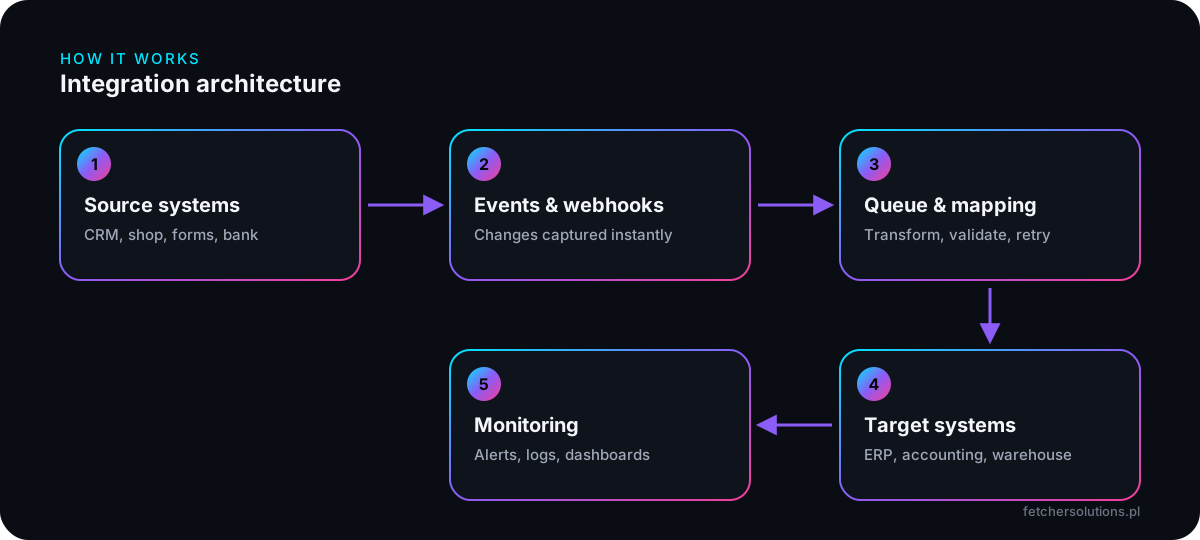
We assume every API will fail at some point and design for it. Events are captured by webhooks, placed in a queue, processed with automatic retries, and logged end to end. If something cannot be resolved automatically, the right person gets an alert with enough context to fix it, before customers or accountants notice.
| Building block | Why it matters |
|---|---|
| Webhooks | Changes are picked up as they happen, not once a night |
| Queues (e.g. Redis) | Spikes are absorbed; nothing is lost if a target system is down |
| Retries | Temporary errors fix themselves without manual work |
| Validation | Bad data is stopped before it reaches the ERP |
| Error monitoring | Failures trigger alerts and are logged for review |
For lighter flows we orchestrate integrations in n8n or Make; heavier ones get custom code in Python or Node. The choice depends on volume, complexity and who will maintain it.
Can integrations handle unstructured data like invoices and emails?
Yes, by adding an AI step. Integrations traditionally require structured input, but much business data arrives as PDFs, scans and free-text emails. A language model can extract the fields first, after which the normal integration validates and posts them. We use this pattern to feed documents straight into accounting and ERP systems.
For a manufacturer in Łódź, invoices arriving by email are read by GPT-5 Vision, checked against the official VAT whitelist and the supplier database, then posted to Comarch Optima with cost centres and VAT rates mapped. Processing time per invoice fell from about 4 minutes to 8 seconds. See the AI accounting case study, and our AI agent development page for more on this approach.
Unusual documents – a new supplier, an amount above a set threshold, a tax ID missing from the whitelist – are not forced through. They go to an approval queue in Slack, and every decision is written to an audit log, so the integration stays as trustworthy as the rule-based flows around it.
How do integrations help an e-commerce business?
In e-commerce, integrations keep stock, orders and shipping in step across the shop, warehouse, carriers and marketing tools. Without them, overselling, late dispatch and manual label printing eat into margin. With them, an order placed at midnight is in the warehouse queue, labelled and confirmed to the customer before anyone starts work.
For the streetwear brand n-hype we made Baselinker the single source of stock for their Shopify store, syncing every 5 minutes, with automatic order statuses and shipping labels. A separate n8n flow publishes each new collection to Instagram, Meta Ads and a Klaviyo newsletter within a minute of going live in Shopify. Collections now launch three times faster. See the n-hype case study.
Typical e-commerce flows we build:
- Shop ↔ warehouse or 3PL stock and order sync.
- Automatic carrier labels and tracking emails.
- Orders and refunds exported to accounting.
- Customer and purchase events sent to your email platform.
If you are also rebuilding the store itself, see our Shopify development service.
How does an integration project run from first call to launch?
It starts with a free 30-minute call where we map your systems and the data flowing between them. Within 48 hours you receive an architecture, sprint timeline and fixed price. We then build in two-week sprints, test against real data, and launch with monitoring in place and a 30-day warranty.
- Focus – which systems, which data, who owns each record, and where errors hurt most.
- Explore – API assessment, data mapping, architecture and fixed-price offer.
- Transpose – build sprints with demos and daily progress in Notion; feedback within 24 hours.
- Commit – staged rollout, often in parallel with the old process until numbers match.
- Handoff – documentation of every flow, credentials and monitoring access.
Running old and new processes side by side for a short period is the safest way to switch: you compare outputs, and only retire the manual process once you trust the integration.
Do you integrate the systems used by companies in other EU countries?
Yes. Integration work is about APIs and data, not geography, and we serve clients in Germany, the UK, the Netherlands, Austria and the Czech Republic. If your ERP, accounting or carrier software has a usable interface, we can connect it. We review its documentation during scoping and flag any limitations before quoting a fixed price.
We work fully remotely on Google Meet, Slack and Notion, during CET business hours, with on-site visits when a project needs them – for example to access an on-premise server. EU B2B clients are invoiced with reverse-charge VAT.
All code is yours: it lives in your repository and runs on your infrastructure, and at the end you receive documentation and every credential.
How much do system and ERP integration services cost?
Integration projects are quoted individually and typically cost between €1,400 and €9,500, depending on the number of systems, data volume and API quality. An ERP integration starts at €1,060, and a simple webhook link between two systems starts at €85. You receive a fixed price within 48 hours of the discovery call.
| Scope | Price | What's included |
|---|---|---|
| Simple API integration | from €85 | Two systems connected via webhook or simple mapping; 24–72 h turnaround |
| ERP integration | from €1,060 | Connection between your ERP and one other system (shop, CRM, portal) |
| Integration project | €1,400–9,500 | Multi-system data flow with queues, retries, validation and monitoring |
| Scale · AI | from €7,000 | ERP/CRM/accounting integration with AI agents, cloud-native architecture, 24/7 SLA |
| Care plan | from €160/mo | Monitoring, fixes after API changes, dev hours |
Final price is fixed after the brief. If a third-party API turns out to behave differently from its documentation, we raise it immediately and agree any change request with you before continuing.
Stop retyping data between systems.
Book a free 30-minute call and we'll map your systems, spot the most expensive manual hand-offs and send a fixed price within 48 hours.
Book a free consultation →Frequently asked questions
Which systems have you integrated?
Our published projects include ERPs such as Subiekt GT and Comarch Optima, HubSpot, Shopify, Baselinker, Klaviyo, Stripe, carriers and Slack. Beyond those, we work with any system that offers a REST or GraphQL API, webhooks or a reliable import and export mechanism.
What happens when one of the connected systems changes its API?
Monitoring flags failing calls straight away, and the queue holds data so nothing is lost while the fix is made. Within the 30-day warranty we fix bugs free of charge; afterwards a Care plan from €160/mo covers adapting integrations to API changes from vendors.
How often does data sync between systems?
It depends on the system. Where webhooks exist, changes flow almost immediately. Where they don't, we schedule syncs – for example every 15 minutes for ERP stock and prices in our B2B portal, or every 5 minutes for warehouse stock in a Shopify store. We agree intervals in the brief.
Is our business data secure during integration?
Each integration gets only the permissions it needs, credentials stay in your accounts, and data runs on infrastructure you control. Every flow is logged so you can see what moved and when. Our launch checklist covers GDPR, and we can keep processing within EU-based hosting.
Do we get documentation of the integrations?
Yes. At handoff you receive documentation of every data flow – sources, targets, field mappings, schedules and error handling – along with the code repository and all credentials. Nothing is vendor-locked, so your own IT team or another provider can maintain the integration later.
Can you invoice EU companies under reverse charge?
Yes. We are registered for EU VAT under PL9472012475, so B2B clients in other member states are invoiced under the reverse-charge mechanism. Invoices are issued in PDF on the payment date, or as a proforma before payment if your procurement process needs one.