- Industry
- E-commerce · streetwear
- Scope
- Custom Shopify theme, performance, Baselinker integration, drop automation, upsell/cross-sell
- Stack
- Shopify · Liquid · Baselinker · n8n · Klaviyo
- Results measured over
- 6 months
Results
Who was this project for?
n-hype.com is a streetwear brand that sells through drops: a collection goes live at a specific moment and the community rushes in during the first few minutes. That traffic pattern is nothing like classic e-commerce, where visits spread evenly across the day.
In streetwear, the store is part of the brand. A customer following a drop on Instagram expects the site to look like the brand — not like one of thousands of shops on the same free theme. So from day one the brief covered two things at once: image and performance under pressure.
What was wrong with the store before?
The store ran on an off-the-shelf Shopify theme that was slow (LCP 4.2s), generic, and couldn't cope with drops — spontaneous collection launches with hundreds of simultaneous visitors. Every launch was a manual job, and inventory lived its own life outside the store.
In practice that meant:
- Slow loading — a 4.2s LCP is seconds of blank screen at the exact moment interest peaks.
- No identity — the stock theme looked like hundreds of other shops, so the brand lost its edge right where it sells.
- Manual launches — publishing the collection, the Instagram post, the ad campaign and the newsletter were separate steps in separate tools.
- Inventory outside the store — without a warehouse integration, order statuses and shipping labels needed manual handling.
What were the project goals?
There were four goals, each straight from the problem list: a distinctive look, speed, launch automation and warehouse integration. We tied every goal to a measurable indicator — conversion rate, LCP, time to launch a collection and store availability during drops.
Equally clear was what we didn't want: a rebuild that looks great in a screenshot but doesn't move sales. That's why every result is measured against the previous theme.
How did we build it, step by step?
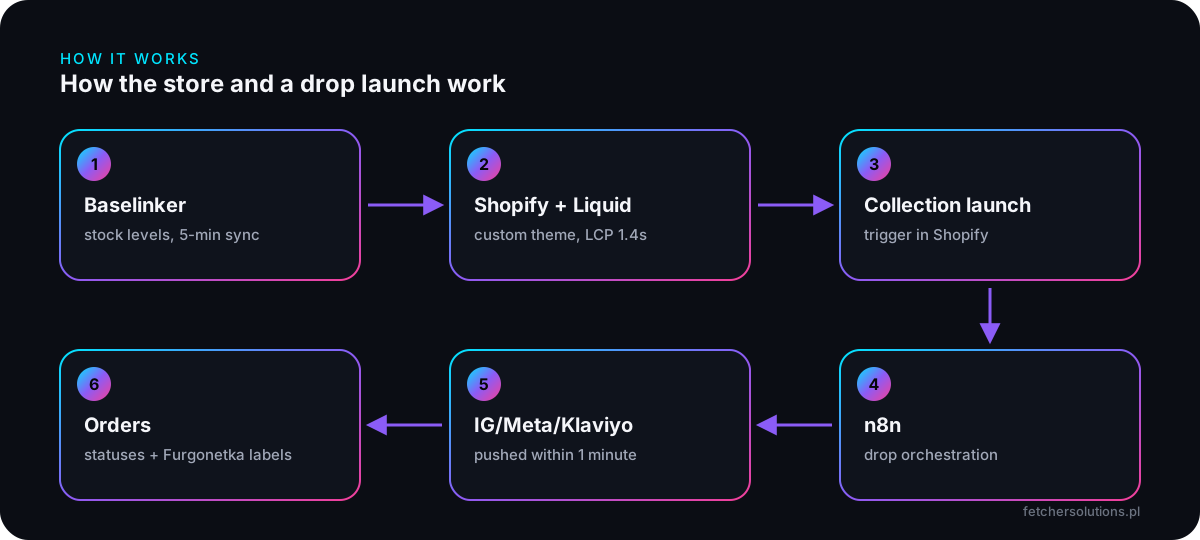
The solution has five layers: a custom Liquid theme, performance optimisation, Baselinker as the inventory source, drop automation in n8n, and upsell/cross-sell driven by browsing history. Each layer fixes one specific problem from the list above.
1. Custom Liquid theme
We wrote the theme in Liquid, Shopify's native templating language, with the brand's identity baked in: a custom product grid, hero animations and drop parallax. The store looks like n-hype, not a template — while staying inside the Shopify ecosystem with its hosting, checkout and apps.
2. Performance
Lazy loading, WebP images, font-display swap and predictive prefetch. Lazy loading only fetches images when they're needed; WebP cuts image weight; font-display swap shows text immediately instead of waiting for the brand font; prefetch anticipates the next page and loads it early. Result: a 1.4s LCP.
3. Baselinker as the inventory source
Stock syncs from Baselinker every 5 minutes, order statuses update automatically, and Furgonetka shipping labels are generated without retyping anything.
4. Drop automation in n8n
Launching a collection in Shopify fires a workflow that pushes the drop to Instagram, Meta Ads and the Klaviyo newsletter within 1 minute. One trigger instead of several manual operations across different dashboards.
5. Upsell and cross-sell
Recommendations based on browsing history lifted average order value (AOV) by 18%.
Why Shopify, Liquid, Baselinker, n8n and Klaviyo?
We picked the stack so the brand keeps full control over its look while operations run on their own. Shopify provides stable hosting and checkout, Liquid gives design freedom, Baselinker keeps inventory in order, n8n orchestrates the launch and Klaviyo handles email.
- Shopify — infrastructure that doesn't require running your own servers for traffic spikes. We compare platforms in Shopify vs WooCommerce.
- Liquid — a custom theme instead of a patched template, so every element is under control.
- Baselinker — a single source of truth for stock and orders, plus the Furgonetka carrier integration.
- n8n — the workflow tying Shopify, Instagram, Meta Ads and Klaviyo together. More on automation in our business process automation guide.
- Klaviyo — a newsletter that goes out together with the drop.
Connecting systems is a discipline of its own — see our system integrations service.
What results did the new store deliver?
In the first 6 months the conversion rate rose 38% versus the previous theme, LCP dropped from 4.2s to 1.4s, collection launches became 3× faster, and drops with 10k+ visits per minute ran with zero downtime. On top of that, upsells added +18% AOV.
| Metric | Before | After |
|---|---|---|
| LCP | 4.2s | 1.4s |
| Conversion rate | previous theme | +38% |
| Collection launch | manual, several tools | 3× faster, pushed in 1 minute |
| AOV | no recommendations | +18% |
What does it mean? Conversion and AOV grew together, so the same traffic produces more revenue. Faster launches mean less operational work on every drop, and zero downtime means the brand's biggest moments don't end in a server error.
Who is a similar project right for?
This kind of build makes sense for DTC brands that sell in drops or campaigns with sudden traffic spikes, compete on design, and want inventory and launch communications to run automatically. If your stock theme is slow and looks like your competitors’, that's the signal.
We start with a 30-minute discovery call; within 48 hours you get a technical brief and a fixed-price quote. Scope and pricing are on our Shopify development page.
„After migrating to a custom Shopify, conversion jumped noticeably. This isn't an agency selling templates — they genuinely understand business and code for results.”
Paul S. · Founder · streetwear brand
Got a similar project?
Let's build it for you: a 30-minute call, a brief and a fixed price.
Book a free consultation →Frequently asked questions
How much does a custom Shopify store cost?
Shopify stores start from €1,850; a store with a custom theme is €3,500 in our calculator, and enterprise projects start from €7,000. The final price is fixed after the brief — it doesn't grow during the project.
How long does a custom Shopify build take?
Typically 4–8 weeks for a Shopify store with custom features. We work in two-week sprints with demos and Notion access, and the timeline is agreed in writing in the brief.
Can Shopify handle a high-traffic drop?
In this project, drops with 10k+ visits per minute ran with zero downtime. The key is Shopify's infrastructure plus a lean, optimised theme (1.4s LCP) that doesn't add bottlenecks of its own.
Can collection launches be pushed to social media automatically?
Yes. At n-hype, launching a collection in Shopify triggers an n8n workflow that publishes the drop to Instagram, Meta Ads and a Klaviyo newsletter within 1 minute. A single workflow starts from €600.