TL;DR
- Document OCR AI agent from €2,800; custom GPT or fine-tune from €1,380
- Scale·AI systems with RAG, ERP/CRM integration and 24/7 SLA from €7,000
- Our invoice agent cut errors from 4% to 0.3% and paid back in 4 months
- Every decision is logged; unusual cases go to a human approval queue
What is an AI agent and how is it different from Zapier?
An AI agent is software that uses a large language model to make decisions in situations nobody coded explicitly. A classic Zapier or Make workflow only does what you spell out: send an email, save a row. An agent reads an invoice in any layout, recognises what a customer wants, or classifies a ticket, then acts.
That does not mean agents replace workflows. In our builds, n8n or Make remains the skeleton that handles triggers, API calls, retries and logging. The language model – GPT-5 or Claude, depending on the task – is the decision layer called at the steps that need judgement.
The split matters for three reasons:
- Cost – you pay for model calls only where reasoning is needed, not for every step.
- Control – deterministic steps stay deterministic and easy to test.
- Auditability – each model decision is a single, logged event you can review.
If most of your process is rule-based, start with business process automation instead and add AI later.
Which business processes can an AI agent take over?
Agents work best on high-volume tasks with messy input: documents, emails, free-text forms, support tickets. Typical examples are invoice reading and posting, lead qualification, email triage, proposal drafting, first-line support and competitor research. The common thread is a person who currently reads something, decides, then types the result into another system.
- Accounting – OCR on cost invoices, cost-centre suggestions, VAT checks, posting to the ERP.
- Sales – enriching and scoring leads, choosing the right rep, drafting personalised follow-ups.
- Operations – reading supplier emails, matching them to orders, flagging delays.
- Customer service – classifying tickets, answering routine ones, escalating the rest.
Our founder, Ziemowit Galant, has deployed more than 20 AI agents for Polish SMEs, and the pattern repeats: the first agent targets the single most tedious task, proves its numbers, and only then do we extend it. For a longer list with costs, read 10 processes you'll automate with AI agents.
What did our AI invoice agent achieve for a manufacturer?
A 50-person manufacturer in Łódź processed about 300 cost invoices a month by hand in Comarch Optima. We built an agent that reads, classifies and posts them automatically. Time per invoice dropped from about 4 minutes to 8 seconds, errors fell from 4% to 0.3%, and 1.5 FTE moved to more valuable work.
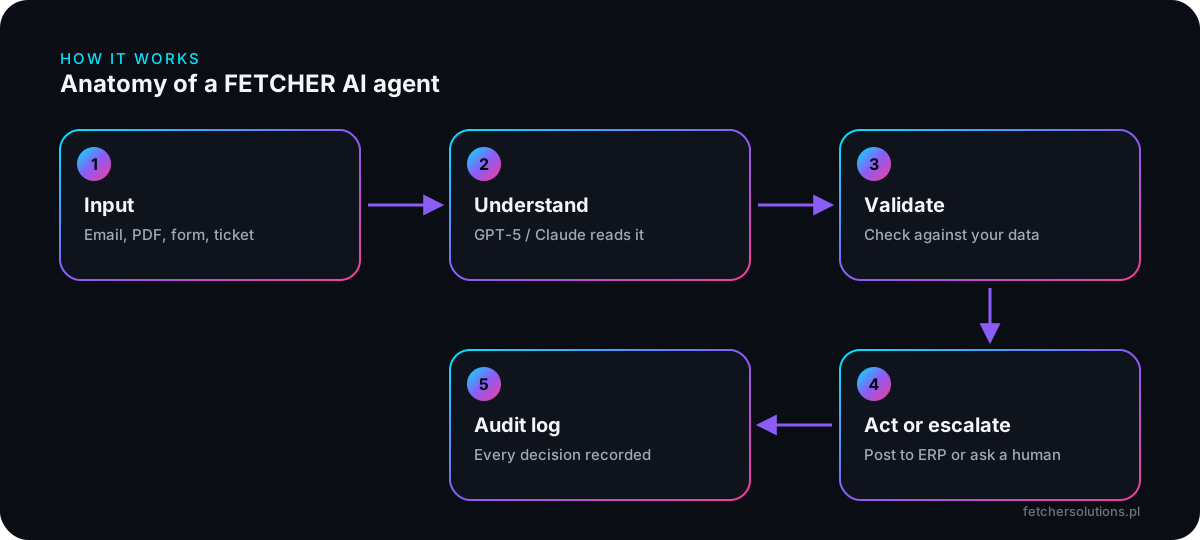
The architecture is a good template for any document agent:
- An n8n mailbox watcher collects PDF and JPG attachments from the invoices inbox.
- GPT-5 Vision extracts the supplier's tax ID, invoice number, date, net, VAT and gross amounts, line items and a proposed cost centre.
- Validation cross-checks the data against the government VAT whitelist API, the supplier database in the ERP and company rules.
- Clean invoices are pushed to Comarch via API with cost centres and VAT rates mapped.
- Unusual ones – new supplier, amount above 10k, tax ID missing from the whitelist – land in a Slack approval queue.
- Every agent decision is logged in Supabase with timestamps.
The project returned its cost in the fourth month. Full write-up: AI accounting automation with OCR and ERP.
When does a custom GPT or fine-tuned model make sense?
A custom GPT or fine-tuned model makes sense when you need a language model that knows your documents, writes in your house style, or must run privately behind your own API endpoint. We start these projects from €1,380. For most knowledge tasks, retrieval-augmented generation over your files beats fine-tuning on cost and freshness.
The options we offer, from lightest to heaviest:
- Custom GPTs – a configured assistant with instructions and reference files for internal use.
- RAG over documents – the model searches a vector index (for example Pinecone) of your manuals, contracts or policies and answers with sources.
- Fine-tuning – the model is trained on your examples to produce a consistent format or tone.
- On-premise LLM – an open model hosted in your infrastructure when data must not leave it.
We will recommend the lightest option that meets the requirement. Fine-tuning a model to “know” a document set that changes every month is usually the wrong tool; a RAG index you can update in minutes is the right one.
How do we keep AI agents accurate and under control?
We treat the model as a capable but supervised colleague. Its outputs are validated against your own data, its permissions are limited to what the task requires, and any case outside defined thresholds goes to a human for approval. Every decision is logged with a timestamp, so you can audit what the agent did and why.
Concretely, each agent we ship includes:
- Validation rules – totals that must add up, IDs that must exist in your ERP, values within expected ranges.
- Escalation paths – a Slack or email approval queue with the agent's proposal attached, so a person decides in one click.
- Audit log – inputs, model output and final action stored for review.
- Monitoring – alerts when error rates or volumes change unexpectedly.
The launch checklist covers GDPR, and we discuss model choice and data processing with you up front, including whether data should stay in EU infrastructure.
How long does it take to build an AI agent?
Build sprints typically run 2–8 weeks depending on integrations and the number of document types or decisions involved. You get a technical brief and fixed price within 48 hours of the discovery call, then two-week sprints with a demo at the end of each. The more systems the agent touches, the closer you get to the top of that range.
We follow the FETCH framework. Focus: a free 30-minute call mapping the process, KPIs and stack. Explore: architecture and fixed-price offer within 48 hours. Transpose: build sprints with daily progress in Notion and feedback within 24 hours. Commit: launch with a checklist and 30-day warranty. Handoff: documentation, credentials and training.
A sensible rollout runs the agent in “shadow mode” first: it proposes, a person approves everything, and you compare its decisions with your team's. Once accuracy is proven on your own documents, thresholds are relaxed and only edge cases still reach a human.
Can an AI agent qualify sales leads?
Yes. For a B2B SaaS company receiving 200+ leads a month, we built an agent that enriches each new HubSpot lead, scores it from 1 to 100 with Claude, routes it to the right rep and starts a personalised follow-up sequence. Within three months sales-qualified leads rose 47% with the same team.
The agent weighs company, size, industry, technology and the intent expressed in the form. Leads scoring 80+ go to the most experienced reps; leads scoring 90+ with no reply after 24 hours are escalated to Slack. Reps spend 62% less time on manual qualification, first response is 2.1× faster, and win rate rose 23% thanks to better lead–rep matching. See the full case study.
Why hire a Polish AI agent developer as an EU company?
You get an engineering team that prices in fixed euros, works in your time zone and invoices under reverse-charge VAT. FETCHER Solutions is based in Łódź and already serves clients in Germany, the UK, the Netherlands, Austria and the Czech Republic through a fully remote process run on Google Meet, Slack and Notion.
We are not a cheap agency, and we do not try to be. What you buy is a team that counts ROI before the build, documents the code, and does not disappear after launch. Behind each agent there is a written timeline, a named contact who picks up the phone, and a Care plan if you want ongoing monitoring.
Practical details for cross-border projects:
- Working hours Mon–Fri, 9:00–18:00 CET, with email replies in under 4 hours.
- All accounts, repositories and model keys registered to your company, not ours.
- On-site visits when a project genuinely needs them.
How much does AI agent development cost?
AI deployments start at €2,800, which is also the starting price of a document OCR agent. A custom GPT or fine-tuned model starts at €1,380. Advanced Scale·AI systems with RAG, ERP or CRM integration, cloud-native architecture and 24/7 SLA start at €7,000. You receive a fixed price within 48 hours of the discovery call.
| Scope | Price | What's included |
|---|---|---|
| Custom GPT / fine-tune | from €1,380 | Model on your data, own API endpoint, privacy, consistent style |
| Document OCR AI agent | from €2,800 | Reading, classifying and posting documents, with validation and approval queue |
| AI deployment | from €2,800 | LLM decision layer inside an n8n/Make workflow |
| Scale · AI | from €7,000 | Custom agents (LLM + RAG), ERP/CRM integration, 24/7 SLA, 6-month roadmap, dedicated PM |
| Care plan | from €160/mo | Monitoring, security patches, dev hours |
All prices are fixed after the brief. If new scope appears during the build, we stop, price the change request separately and continue only after your approval.
Find the task your first agent should own.
In a free 30-minute call we'll pick the highest-value process, sketch the agent's architecture and give you a fixed price within 48 hours.
Book a free consultation →Frequently asked questions
Which language models do you use?
We mostly work with GPT-5 and Claude, chosen per task – for example GPT-5 Vision for reading invoices and Claude for lead scoring and support. For document search we add a vector database such as Pinecone. Where data must stay in-house, an on-premise model is an option.
Can an AI agent read documents in German or English?
Yes. The models we use handle English, German and Polish documents, and the validation rules are configured for your suppliers, tax IDs and accounting conventions. We test the agent on a sample of your real documents before launch, so accuracy is measured rather than assumed.
Will the agent work with our ERP or CRM?
If the system has an API or a reliable import mechanism, yes. We have connected agents to Comarch and HubSpot, and integration with your ERP or CRM is part of the Scale·AI scope. If no API exists, we discuss alternatives during the discovery call before you commit.
Who owns the agent, the prompts and the code?
You do. Code lives in your GitHub repository, workflows and model accounts are registered to your company, and at handoff you get every password and full documentation. Nothing is vendor-locked, so you can maintain or extend the agent with another team if you choose.
What happens if the agent makes a mistake?
Validation and approval queues are designed to catch errors before they reach your systems, and every decision is logged so you can trace it. Bugs found after launch are fixed free within the 30-day warranty; ongoing tuning is covered by a Care plan from €160/mo.
Do you invoice EU companies with reverse-charge VAT?
Yes. We are registered for EU VAT under PL9472012475, so B2B clients elsewhere in the EU are invoiced under the reverse-charge mechanism. You can receive a proforma before payment, and the final invoice is issued in PDF on the payment date.