TL;DR
- SEO + GEO retainer from €450/mo; full technical audit from €350
- Quick-win audit with top 5 fixes in PDF from €115; GBP setup from €90
- Local client result: #1 in Google and top 3 in Maps within 4 months
- GEO work covers Schema, llms.txt, authorship and citable content
What is the difference between SEO and GEO?
SEO gets your pages ranked in Google's results. GEO, generative engine optimisation, gets your business named and cited when people ask AI assistants such as ChatGPT, Perplexity or Claude. They share foundations – technical health, authority, clear content – but GEO puts extra weight on structured facts and direct, quotable answers.
A growing share of research now starts with a question typed into an AI assistant rather than a search box. When that assistant recommends three agencies, three clinics or three suppliers, you want to be one of them. That depends on how clearly your website states who you are, what you offer, where, and at what price. Vague marketing copy that never names a price, a city or a concrete result gives an AI engine nothing it can safely repeat.
| SEO | GEO | |
|---|---|---|
| Goal | Rank pages in Google | Be cited in AI answers |
| Key signals | Relevance, links, technical health | Clear facts, structure, authorship, consistency |
| Typical work | Audits, content, links, GBP | Schema, llms.txt, answer-first content |
We run both together, because the same work usually serves both.
What does an SEO and GEO audit include?
Our technical audit, from €350, checks crawling and indexing, Core Web Vitals, site structure, internal linking, Schema.org markup, content gaps and how AI engines currently describe your business. You receive a prioritised list of fixes, ordered by expected impact and effort, so your developers or our team know exactly where to start.
What we look at:
- Technical – indexing errors, redirects, duplicate pages, sitemap, robots rules, page speed.
- On-page – titles, headings, meta descriptions, internal links, thin or overlapping pages.
- Structured data – Organization, LocalBusiness, Service, FAQ and Product markup.
- Authority – backlink profile, reviews, Google Business Profile completeness.
- AI visibility – whether assistants mention you, and what facts they get right or wrong.
On a tighter budget? The quick-win audit from €115 covers on-page, Schema and Core Web Vitals and delivers your top five fixes in a PDF.
How do you get a business cited by ChatGPT, Perplexity and Claude?
AI assistants cite sources that state facts clearly, consistently and verifiably. We restructure key pages so each one answers a real question directly in its opening sentences, add Schema.org markup describing your organisation and services, publish an llms.txt file, strengthen authorship signals, and make your name, address and offer consistent everywhere they appear online.
In practice, GEO content follows a few rules:
- Answer first – a 40–60 word direct answer under each question heading, then the detail.
- Self-contained facts – sentences that make sense when quoted alone: who, where, what, how much.
- Visible authorship – real people with real expertise behind the content.
- Structure – lists, tables and FAQs that machines parse easily.
- Consistency – the same facts on your site, Google Business Profile and directories.
Our founder runs GEO audits for companies and writes about the method in GEO: how to appear in ChatGPT, Perplexity and Claude.
How does local SEO win customers from your area?
Local SEO puts your business in Google's map pack and local results when people nearby search for what you do. It rests on a complete Google Business Profile, location-specific content, LocalBusiness Schema, local backlinks and a steady flow of genuine reviews. For service businesses, restaurants and clinics it is often the most profitable channel.
For sushisoul.pl, a sushi restaurant in Łódź competing with 40+ local rivals, the starting point was position 15+ in Google Maps and an incomplete profile. We filled the Google Business Profile completely, added LocalBusiness and Restaurant Schema and 50+ photos, rebuilt the website, and set up an automatic SMS after each visit asking for a Google review.
Within four months the restaurant ranked #1 in Google for its main local keyword and in the top 3 of the Maps local pack. Online reservations grew 240%, and the average rating rose from 4.3 across 40 reviews to 4.8 across 180+. Full story: sushisoul case study; method: local SEO guide 2026.
What happens each month on an SEO and GEO retainer?
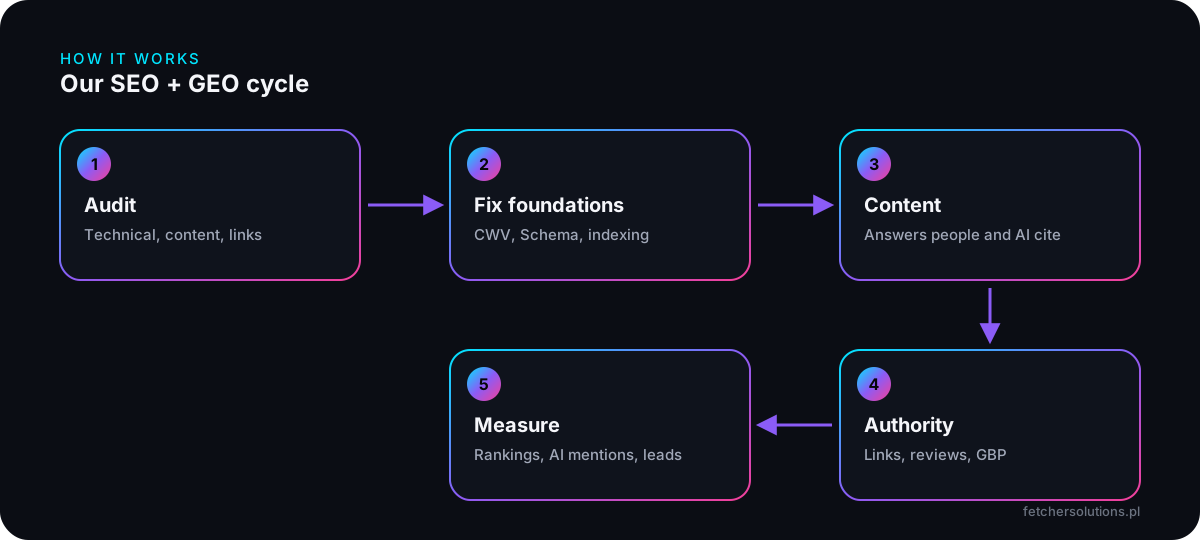
A retainer from €450/mo turns the audit into steady progress. Each month we fix technical issues, publish or improve content around the questions your customers ask, build authority through links and reviews, maintain your Google Business Profile, and report rankings, traffic, leads and AI mentions in plain language with next month's priorities.
A typical month includes:
- Technical fixes from the audit backlog, in priority order.
- New or rewritten pages targeting agreed keywords and questions.
- Schema updates as services, prices and FAQs change.
- Link building and local citations relevant to your market.
- Google Business Profile posts, photos and review management.
- A short report with what changed, what moved and what comes next.
We agree goals at the start – usually leads or bookings rather than vanity rankings – and measure against them in GA4 and Search Console. If those are not set up yet, configuration starts at €110.
Why does technical SEO still matter in the age of AI search?
Because neither Google nor AI engines can cite what they cannot crawl, load and understand. Slow pages, broken redirects, blocked resources and missing structured data weaken rankings and make your content harder for AI systems to extract. Technical health is the foundation; content and authority only pay off once it is solid.
The issues we fix most often:
- Core Web Vitals – slow LCP from oversized images, render-blocking scripts or heavy themes.
- Indexing – important pages excluded, or thin duplicates crowding them out.
- Redirect chains – left behind by past redesigns and domain moves.
- Missing Schema – no machine-readable description of your organisation, services or prices.
- Weak internal linking – key service pages buried several clicks deep.
Some fixes are minutes of work, others need a developer. Where your site needs deeper changes, our team can implement them directly; a single fix or debug job starts at €70, and domain or DNS migration with 301 redirects at €70.
Can you run SEO for several countries and languages?
Yes. For companies selling across the EU we plan international SEO from the site structure up: separate language versions, correct hreflang tags, localised Schema and Open Graph data, and keyword research for each market rather than translated keywords. Site translation into English, German or Polish with full hreflang setup starts at €190.
We work with clients in Germany, the UK, the Netherlands, Austria and the Czech Republic. Each market has its own search habits, competitors and local directories, so content and link building are planned per country, while technical foundations stay shared. A strong page in one language does not rank automatically in another; each version needs its own research and its own local signals.
Planning a new site at the same time? Our web development team builds SEO and GEO structure in from the first sprint, which costs far less than retrofitting it later.
How does an engagement with FETCHER start?
With a free 30-minute call where we look at your site, competitors and goals. Within 48 hours you receive a written scope and a fixed price for the audit or retainer. Work then runs in monthly cycles with progress visible in Notion, and you keep full access to every account, tool and report.
The FETCH framework applies here too: Focus on the business goal, Explore the site and market, Transpose findings into fixes and content, Commit to measurable monthly priorities, and Handoff everything – documentation and access – so the work stays yours if you ever move on.
If your discovery call shows that the website itself is holding you back – an outdated platform, poor mobile performance, no room for new content – we will say so plainly, and explain whether fixing or rebuilding is the better investment.
How much does SEO and GEO cost?
An SEO and GEO retainer starts at €450 per month. A full technical audit starts at €350, and a quick-win audit with your top five fixes starts at €115. Google Business Profile setup starts at €90 and GA4 with Search Console at €110. The Growth package includes a three-month SEO campaign. All prices are fixed after the brief.
| Scope | Price | What's included |
|---|---|---|
| Google Business Profile setup | from €90 | Full profile configuration, photos, Schema, first posts |
| GA4 + GSC setup | from €110 | Analytics, Tag Manager, conversion events, Search Console |
| SEO quick-win audit | from €115 | On-page, Schema and CWV analysis – top 5 fixes in PDF |
| Site translation (PL/EN/DE) | from €190 | Hreflang, Schema and Open Graph localisation |
| Technical SEO + GEO audit | from €350 | Full audit with a prioritised fix list and AI visibility check |
| SEO + GEO retainer | from €450/mo | Technical fixes, content, links, GBP, monthly reporting |
Retainer scope and monthly priorities are agreed in writing. An audit can be ordered on its own, before you decide on a retainer.
Find out what Google and ChatGPT say about you.
Book a free 30-minute call and we'll check your rankings, Google Business Profile and AI visibility, then suggest the first three fixes.
Book a free consultation →Frequently asked questions
How long does SEO take to show results?
Technical fixes and Google Business Profile improvements can show effects quickly, while content and authority build over months. For our local restaurant client, the #1 position and top-3 Maps ranking came within four months. We set realistic milestones in the brief instead of promising overnight rankings.
Can you guarantee a #1 position in Google?
No honest agency can, because Google and AI engines control their own results. What we commit to is a written plan, the work itself, and transparent reporting on rankings, traffic, leads and AI mentions. Our results come from that process, not from promises.
What is llms.txt and do we need it?
llms.txt is a plain-text file at the root of your website that summarises who you are and points AI systems to your most important pages. It is a light, low-cost addition to a GEO setup. We add it alongside Schema markup and answer-first content, which matter more on their own.
Do you write the content or do we?
Either works. On a retainer we can write content around agreed keywords and questions, or edit and optimise drafts from your experts. For specialist topics, the best results usually combine your knowledge with our structure, because visible authorship is a strong signal for both Google and AI engines.
Will we own the accounts and reports?
Yes. Google Business Profile, GA4, Search Console and any tools are registered to your company, and we work with delegated access. Reports and documentation stay with you. Nothing is vendor-locked, so you can bring SEO in-house or change agency without losing data or history.
How do you invoice clients outside Poland?
We are registered for EU VAT under PL9472012475, so B2B clients in Germany, the Netherlands, Austria and other member states are invoiced under the reverse-charge mechanism. Monthly retainers are invoiced in PDF, with a proforma available before payment if needed.