TL;DR
- Website or WhatsApp chatbot with RAG from €820
- Voice AI answering calls 24/7 in EN / DE / PL from €1,900
- A Claude-based support agent resolved 70% of L1 tickets for a DTC brand
- Simple single-purpose WhatsApp or Slack bot from €210
What can an AI chatbot do for a business in 2026?
A modern AI chatbot answers customer questions in natural language using your own documents, not a script of canned replies. It can check order status, book appointments, qualify enquiries and collect contact details, then pass complex cases to your team with the full conversation attached. It works day and night without extra headcount.
The difference from the decision-tree bots of a few years ago is comprehension. Customers no longer have to click the right button; they type or say what they need, and the model works out the intent. Where to deploy it:
- Website chat – product questions, pricing, shipping, returns.
- WhatsApp and Messenger – the channels many customers already use daily.
- Phone – a voice agent that picks up, understands the caller and acts.
- Internal – a Slack assistant that answers staff questions from your policies.
We build on Claude or GPT-5, with ElevenLabs for natural-sounding voices.
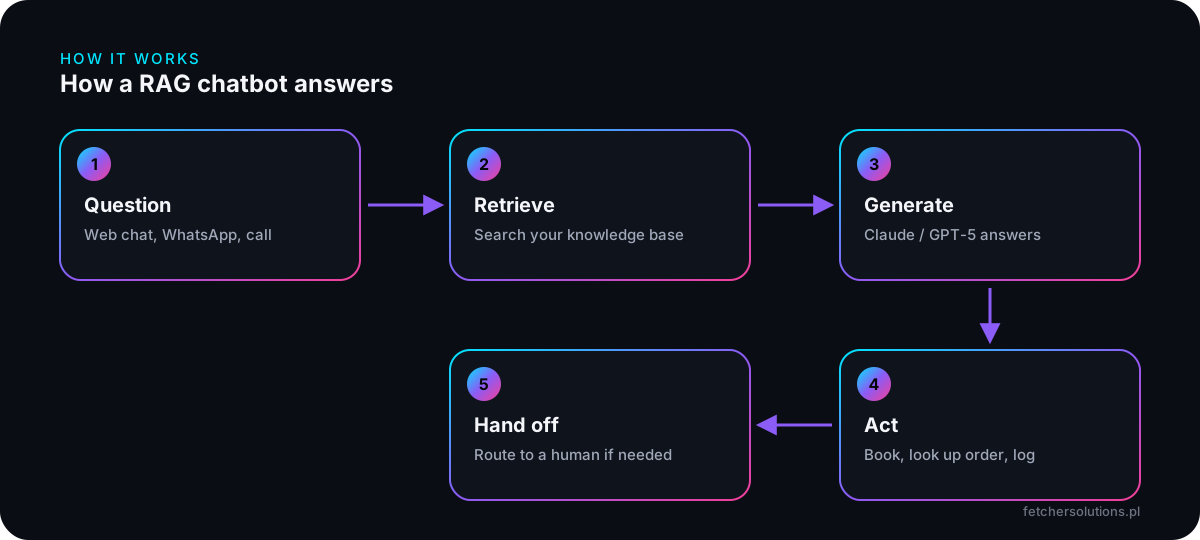
How does RAG stop a chatbot from making things up?
Retrieval-augmented generation (RAG) makes the chatbot look up relevant passages in your knowledge base before it answers, and instructs the model to answer only from what it found. If the information is not there, the bot says so or hands over to a person, instead of inventing a plausible-sounding reply.
The knowledge base can be your help centre, product catalogue, terms and conditions, internal manuals or past ticket replies. We split the content into passages, index them in a vector database such as Pinecone, and connect the index to the model. When you update a document, the index updates with it – no retraining needed.
On top of RAG we add guardrails:
- A clear scope: the bot declines topics outside your business.
- Confidence checks that trigger a handoff when the answer is uncertain.
- Conversation logs you can review to spot gaps in the knowledge base.
Our article on AI agents for business explains where chatbots end and fully autonomous agents begin.
Can a voice AI agent answer our phone calls?
Yes. A voice agent picks up incoming calls, understands the caller, answers common questions, books appointments and routes urgent matters to a person. We build voice agents in English, German and Polish from €1,900, using ElevenLabs for speech, Claude for reasoning and Twilio for telephony. It answers 24/7, including evenings and weekends.
One of our deployments is a voice agent for a law firm. It answers 100% of after-hours calls, classifies the legal matter, schedules consultations and emails a summary of each call to the lawyers. Nobody misses a new client because the office was closed.
Typical voice use cases:
- Bookings for clinics, salons, restaurants and service businesses.
- First-line triage for professional services before a specialist calls back.
- Order and delivery status lines for e-commerce and distribution.
For companies serving several EU markets, one agent can handle callers in English, German and Polish, which is often cheaper than staffing a multilingual line. Callers who prefer a person can always ask for one, and the agent transfers or schedules a callback.
What results has an AI support agent delivered?
For matchanhype.com, a direct-to-consumer matcha brand on Shopify, we automated customer support with an AI agent built on Claude. It resolves 70% of first-line tickets on its own, so the team only handles the conversations that genuinely need a person. It was part of a wider subscription and retention project.
That project moved the brand from one-off purchases to subscriptions, with Klaviyo flows for welcome, post-purchase education, win-back and referrals. Over six months customer lifetime value grew 2.4× and 90-day retention rose 52%, while conversion stayed stable. The support agent kept response times short as the subscriber base grew, without hiring.
Read the full story in the matchanhype subscription case study. If your support also needs order lookups or returns processing in your store, we connect the bot to Shopify or your helpdesk so it can act, not just talk.
Which systems can the chatbot connect to?
The chatbot connects to anything with an API: Shopify, your CRM such as HubSpot, helpdesks, booking calendars, Slack and email. That lets it check an order, create a ticket, reserve a slot or log a lead instead of just pointing customers elsewhere. We orchestrate those actions with n8n, so each step is logged and retried on failure.
| Channel or system | What the bot can do there |
|---|---|
| Website | Answer questions, capture leads, recommend products |
| WhatsApp / Messenger | Same answers in the customer's preferred app |
| Phone (Twilio) | Take calls, book, triage, send call summaries |
| Shopify / helpdesk | Order status, returns, ticket creation |
| CRM / Slack | Log leads, alert your team, escalate conversations |
If the integration work is substantial – an ERP, a warehouse system – it is scoped as part of our system integration services.
Is an AI chatbot the right fit for your business?
A chatbot pays off when the same questions arrive every day and the answers already exist somewhere in your documents. Shipping, returns, opening hours, pricing, availability and booking requests are ideal. It is a poor fit when every enquiry is unique, highly sensitive, or needs a negotiation only an experienced person can handle.
A quick way to check: export last month's emails, chats or call notes and sort them by topic. If a handful of topics cover most of the volume, a bot can take them over and your team keeps the interesting conversations. If the list is long and varied, start smaller – one channel, one topic – and expand once the numbers prove themselves.
Signs you are ready:
- Your team copies the same answers from a document into replies every day.
- Customers contact you outside office hours and wait until the next morning.
- Calls go to voicemail during busy periods and some callers never ring back.
- You serve several EU markets and cannot staff every language at every hour.
If several of these apply, a bot will earn its place quickly.
How do you measure whether the chatbot is working?
We agree the metrics before the build, not after launch. The usual set is the share of conversations resolved without a person, the handoff rate, response time, customer ratings at the end of a chat, and the actions completed – bookings made, leads captured, orders looked up. All of them come straight from the conversation logs.
In the first weeks we review a sample of real conversations with you. Unanswered questions point to gaps in the knowledge base; wrong handoffs point to rules that need tuning. Fixing those is usually a matter of adding a document or adjusting a prompt, not rebuilding the bot.
For a wider view, conversation data can feed a dashboard alongside sales and support figures, so you see whether faster answers translate into more bookings or fewer cancelled orders.
How do we build and launch your chatbot?
We follow the FETCH framework: a free 30-minute discovery call, a fixed-price brief within 48 hours, two-week build sprints with a demo each time, and launch with a 30-day warranty. Before going live, the bot is tested against real questions from your inbox or call logs, so you can judge its answers on your own material.
- Focus – we list the top questions customers ask and the actions the bot must perform.
- Explore – architecture, channels, handoff rules and a fixed price.
- Transpose – knowledge base indexing, prompts, integrations and voice setup in sprints, with progress in Notion.
- Commit – launch with a GDPR-aware checklist, then monitoring of real conversations.
- Handoff – documentation and training so your team can update content themselves.
After launch, a Care plan from €160/mo covers monitoring, prompt tuning and knowledge base updates.
How much does an AI chatbot for business cost?
An AI chatbot with RAG over your knowledge base starts at €820. A voice agent answering calls in English, German or Polish starts at €1,900. A simple single-purpose WhatsApp or Slack bot starts at €210. Ongoing model and telephony usage depends on volume, and the build price is fixed after the brief.
| Scope | Price | What's included |
|---|---|---|
| WhatsApp / Slack bot | from €210 | Simple bot for one use case, deployed on a VPS |
| AI chatbot (RAG) | from €820 | Website, WhatsApp or Messenger chat answering from your knowledge base |
| Voice AI (EN/DE/PL) | from €1,900 | Phone agent: answers 24/7, books, triages, routes to humans |
| AI deployment | from €2,800 | Chatbot plus actions in your systems (orders, CRM, helpdesk) |
| Care plan | from €160/mo | Monitoring, prompt tuning, knowledge base updates |
Fixed price agreed in the brief. Extra scope is priced as a separate change request and only starts after your approval.
Let your next 1,000 questions answer themselves.
Book a free 30-minute call, bring your most common customer questions, and we'll show you how a chatbot or voice agent would handle them.
Book a free consultation →Frequently asked questions
Which languages can the chatbot and voice agent speak?
Our voice agents are built for English, German and Polish, and text chatbots work in the same languages. One deployment can serve customers in several markets, detecting the language of each conversation. We test each language on real questions before launch rather than assuming quality.
Will customers know they are talking to AI?
We recommend saying so openly in the greeting. It sets expectations, builds trust, and lets customers ask for a person at any time. The bot is configured to hand the conversation to your team with full context, so nobody has to repeat themselves.
Where is the conversation data stored?
In accounts and infrastructure registered to your company. We configure logging so you can review conversations, and the launch checklist includes GDPR. At handoff you receive every password, the repository and documentation – nothing is locked to FETCHER's accounts. Model providers process requests under their own terms, which we review with you.
How do we update what the bot knows?
You update the source documents – help articles, policies, product data – and the RAG index refreshes from them. No model retraining is needed. We train your team at handoff, and a Care plan from €160/mo can cover ongoing content and prompt updates if you prefer.
What does the chatbot cost to run each month?
Running costs are model usage, vector database and, for voice, telephony and speech minutes. They depend on conversation volume, so we estimate them during scoping from your current ticket or call numbers and show them separately from the fixed build price, so nothing comes as a surprise.
Do you work with companies outside Poland?
Yes. We work with clients in Germany, the UK, the Netherlands, Austria and the Czech Republic through a fully remote process on Google Meet, Slack and Notion. EU B2B clients are invoiced under reverse-charge VAT using our EU VAT number PL9472012475.