- Industry
- B2B · SaaS
- Volume
- 200+ leads per month
- Scope
- Lead enrichment, AI scoring, routing, auto follow-up, escalation, dashboard
- Stack
- n8n · HubSpot · Clearbit · GUS API · Claude · GPT-5 · Slack · Looker Studio
- Results measured over
- 3 months
Results
Who was this project for?
The client is a B2B company in the SaaS space receiving 200+ leads a month from its website form and Meta Ads campaigns. Leads landed in HubSpot, but everything after that depended on manual work by the sales reps.
In B2B sales, response time and choosing who to talk to first often decide whether a conversation happens at all.
What problem did the sales team have?
A rep received a bulk batch of 50 leads a week from the form and Meta Ads. Instead of talking to people ready to buy, they spent time on verification: who is this, which company, is it worth it? The most valuable leads — the “big fish” — got lost in the noise.
- Manual qualification — researching each lead took time that should have gone into conversations.
- No prioritisation — a lead from a large company with clear intent sat in the same queue as a random enquiry.
- Slow first response — at that volume, some leads went cold before anyone got in touch.
What were the project goals?
The goal was a system that picks the most promising prospects on its own and launches a sequence for them — increasing SQLs without growing the team. Metrics: SQL count, rep time on qualification, time to first response and win rate.
The principle: automation doesn't replace the rep. It takes research and routine follow-up off their plate and hands them leads in an order that makes business sense.
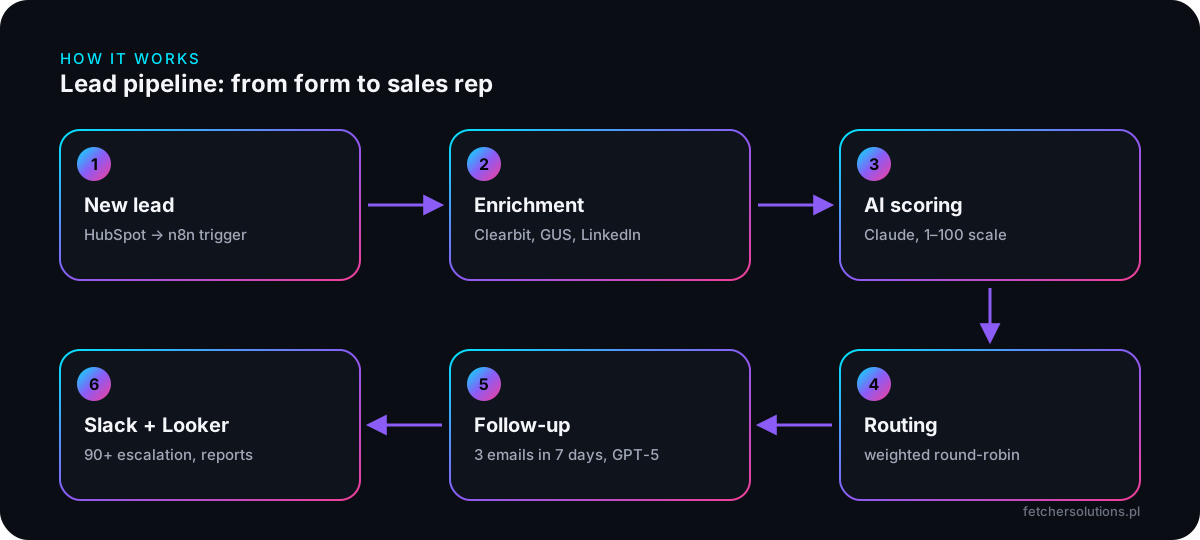
How does the lead pipeline work, step by step?
The pipeline has seven parts: an n8n trigger on new HubSpot leads, data enrichment, AI scoring with Claude, rep routing, automated follow-up, Slack escalation and a Looker Studio dashboard. A lead goes from form to the right person with no manual research.
1. Trigger (n8n)
Every new lead in HubSpot fires an n8n workflow.
2. Enrichment
Clearbit supplies company and technology data, the Polish GUS registry API adds company ID and revenue, and LinkedIn adds job title and career history. The system has the full picture before anyone opens the record.
3. AI scoring (Claude)
Claude scores each lead from 1 to 100 based on company, size, industry, technology and the intent expressed in the form. A language model understands what people actually wrote — something rigid point-based rules can't do.
4. Routing
Rep assignment by round-robin, weighted by experience for leads scoring 80+. The best leads go to the people best at closing them.
5. Auto follow-up
Three emails over 7 days, personalised by GPT-5, with a calendar slot link.
6. Escalation
Leads scoring 90+ with no reply after 24 hours are pushed to Slack so they don't slip away.
7. Looker Studio dashboard
Score vs. close, conversion per rep and categorisation of lost leads — so you can see whether the scoring predicts what it should.
Why n8n, HubSpot and AI scoring?
HubSpot stays the central CRM, n8n ties data sources and process steps together, Claude scores leads, GPT-5 writes personalised emails, Slack handles escalation and Looker Studio tracks results. It's our typical pattern: n8n as the skeleton, an LLM as the brain.
- n8n — flexible orchestration of multiple APIs in one workflow.
- Claude — scoring based on data and form content, not just dropdown fields.
- GPT-5 — personalised follow-ups.
- Looker Studio — a dashboard to verify and fine-tune the scoring.
More examples in 10 processes you'll automate with AI agents and our business process automation guide.
What did AI scoring deliver after 3 months?
After 3 months SQLs were up 47% with the same team, rep time on manual qualification was down 62%, first responses were 2.1× faster, and win rate rose 23% thanks to better lead–rep matching.
| Metric | Change after 3 months |
|---|---|
| SQLs | +47% |
| Time on manual qualification | −62% |
| First response | 2.1× faster |
| Win rate | +23% |
The numbers tell one story: time recovered from research went into conversations with better leads, and faster responses plus smarter routing turned into more wins. Without hiring more reps.
The dashboard plays one more role: comparing scores with actual closes and categorising lost leads shows where the model judges well and where the criteria should change. Scoring isn't set once and forgotten — it can be tuned deliberately based on data.
Who is a similar project right for?
This makes sense for B2B companies with a steady inflow of leads from several sources, where reps spend a lot of time qualifying and valuable enquiries get lost in the crowd. If your team works in HubSpot or another CRM with an API, the architecture transfers.
A single workflow starts from €600 and AI deployments from €2,800. We start with a 30-minute call and deliver a brief with a fixed price within 48 hours. Details on our business process automation and AI agents pages.
Is your sales team drowning in leads?
We'll show you how to automate qualification and lift conversion without growing the team.
Book a free consultation →Frequently asked questions
How is AI scoring different from classic CRM lead scoring?
Classic scoring adds up points for fields. AI scoring (here: Claude, 1–100 scale) also evaluates the form content and expressed intent, combining it with company, size, industry and technology data.
How much does CRM automation with AI cost?
A single n8n workflow starts from €600, AI deployments from €2,800, and a Looker Studio BI dashboard from €680. The price is fixed after the brief.
Do we need to switch CRM?
No. In this project HubSpot stayed the central CRM and n8n connected to it via a new-lead trigger. A similar pipeline can be built on any CRM with an API.
What happens to top leads if nobody replies?
Leads scoring 90+ with no reply after 24 hours are automatically escalated to Slack, so they don't get buried in a rep's inbox.