TL;DR
- Custom Shopify stores from €1,850; enterprise from €7,000; Growth package from €3,500
- Advanced custom stores ship in 4–8 weeks, with a fixed price agreed up front
- n-hype.com: +38% conversion and LCP cut from 4.2 s to 1.4 s after our custom theme
- Migrations from WooCommerce and Magento, 3PL sync, Stripe, Klaviyo and carriers
Why choose a custom Shopify theme over a template?
A custom theme is built for your brand, your catalogue and your traffic, so it loads faster and converts better than a template shared by thousands of shops. Templates carry code for features you never use, which slows pages down. We write themes in Liquid and JavaScript that include only what your store needs.
Templates are a fine starting point for a brand testing the market. They become a ceiling when you need a distinctive look, unusual product logic or performance under heavy traffic. Signs you have hit that ceiling:
- Your store looks like your competitors' because it is built on the same theme.
- Product pages take several seconds to load on mobile.
- Every new section means another app with another monthly fee.
- Launch days slow the site down just when the most people are watching.
Not ready for a full rebuild? We also build single custom sections – a homepage block, product card, filters or lookbook – from €115.
How does a WooCommerce to Shopify migration work?
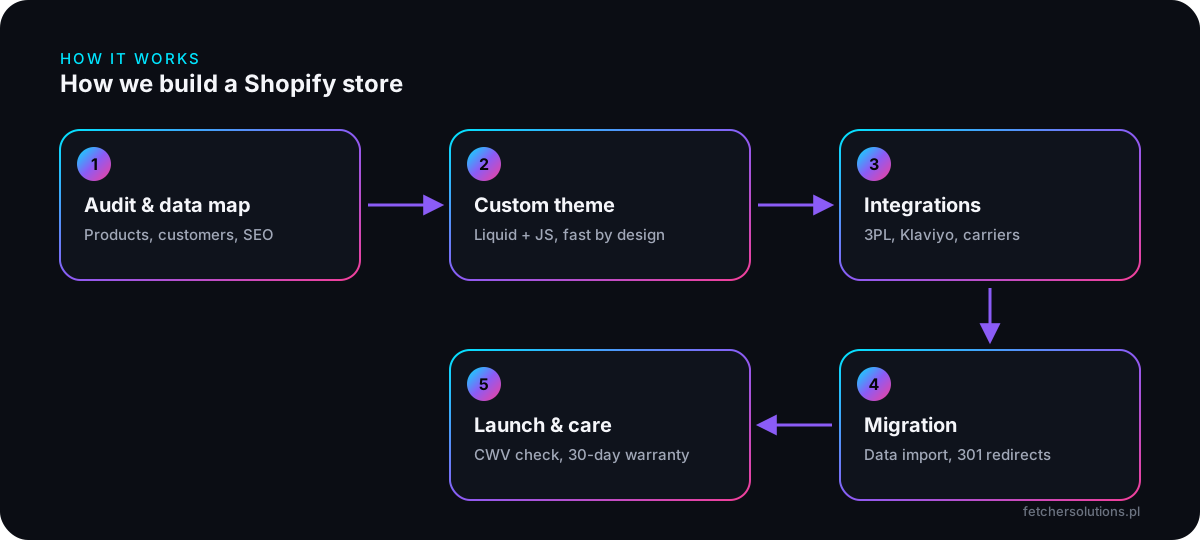
We map your data, build the new store in parallel, migrate products, customers and order history, then switch over with 301 redirects so search rankings carry across. Your existing shop keeps selling until launch day. The switch itself is a planned, short operation, not a weekend of downtime.
- Audit – catalogue structure, variants, customer data, apps and integrations in use, and the URLs that bring organic traffic.
- Data mapping – how WooCommerce or Magento fields translate to Shopify products, metafields and collections.
- Build – the new theme and integrations on a development store.
- Migration – products, customers and order history imported and spot-checked.
- Redirects and launch – old URLs redirected to their new equivalents, DNS switched, launch checklist run.
Is migration right for you at all? Our comparison Shopify vs WooCommerce in 2026 covers real costs, scalability and integrations, including when staying put makes more sense.
What results did a custom Shopify build deliver for n-hype?
n-hype.com, a streetwear brand, moved from a slow generic theme to a custom Shopify build. Over the first six months conversion rate rose 38% against the old theme, mobile LCP dropped from 4.2 to 1.4 seconds, collections launched three times faster, and the store stayed up during drops with over 10,000 visits a minute.
What we built:
- Custom Liquid theme – brand-specific product grid, hero animations and drop parallax.
- Performance work – lazy loading, WebP images, font-display swap and predictive prefetch.
- Baselinker as the stock source, syncing every 5 minutes, with automatic order statuses and Furgonetka shipping labels.
- Drop automation in n8n – a collection launch in Shopify triggers Instagram, Meta Ads and a Klaviyo newsletter within a minute.
- Upsells and cross-sells based on browsing history, lifting average order value by 18%.
“After migrating to a custom Shopify, conversion jumped noticeably. This isn't an agency selling templates — they genuinely understand business and code for results.” – Paul S., Founder, streetwear brand
Full story: n-hype custom Shopify case study.
Which integrations can you add to a Shopify store?
We connect Shopify to the systems your operations already run on: warehouses and 3PL providers, carriers, payment gateways such as Stripe, Klaviyo for email and SMS, subscription apps, accounting and ERP. Stock, orders and statuses then flow automatically instead of being copied by hand between dashboards.
| Area | Typical integration |
|---|---|
| Fulfilment | 3PL or warehouse sync, Baselinker, automatic shipping labels |
| Marketing | Klaviyo flows, Meta Ads, launch automations in n8n |
| Payments | Stripe and Shopify Payments |
| Retention | Subscriptions with flexible frequency, pause and product swap |
| Finance | Accounting and ERP export |
For a matcha DTC brand we combined Shopify, Recharge subscriptions and Klaviyo flows; within six months 38% of customers were on subscription and LTV grew 2.4×. See the matchanhype case study. Heavier ERP work is scoped under system integrations.
How long does a custom Shopify store take?
An advanced Shopify store with custom features takes 4–8 weeks from signed brief to launch. Simpler stores are faster; migrations with large catalogues or several integrations sit at the upper end. You get the exact timeline in writing within 48 hours of the discovery call, and it is part of the fixed-price offer.
The work runs in our FETCH framework: Focus (a free 30-minute call), Explore (brief, architecture and price in 48 hours), Transpose (two-week sprints with a demo at the end of each and daily progress in Notion), Commit (launch checklist covering Core Web Vitals, SEO and GDPR, plus a 30-day warranty) and Handoff (documentation, access and team training).
You can review every sprint on the development store, so there are no surprises on launch day. If new requirements appear mid-build, we pause, price the change request separately and continue only once you approve it – the original fixed price does not creep.
Why does Shopify store speed matter so much for sales?
Speed decides whether a mobile visitor sees your product or gives up waiting. Slow product pages lose shoppers before they scroll, and Google uses Core Web Vitals as a ranking signal. That is why performance is built into our themes from the first line of code, not bolted on later with an optimisation app.
The techniques are not secret, but they need discipline across the whole theme:
- Images served in modern formats such as WebP, sized for each screen and lazy-loaded below the fold.
- Fonts loaded with font-display swap so text appears immediately.
- Scripts kept lean: fewer apps injecting code, more native theme features.
- Prefetching of likely next pages so navigation feels instant.
On n-hype, those changes alone took mobile LCP from 4.2 to 1.4 seconds. Speed also protects launch days: when a drop pulls thousands of visitors at once, a lean theme on Shopify's infrastructure keeps the checkout open instead of stalling.
Already on Shopify and only fighting a slow LCP or a broken checkout? Our site fix and debug service starts at €70.
What should you prepare before a Shopify project starts?
Three things speed up any Shopify build: a clean product export, a list of the apps and integrations you rely on, and access to your analytics. With those, our audit takes days rather than weeks and the fixed price reflects reality. You do not need a finished design brief; shaping it is part of our work.
A short checklist we send before the brief:
- Product and customer exports from your current platform, even if they are messy.
- Your top landing pages from Google Search Console or GA4.
- Logins or API documentation for your warehouse, 3PL, carriers and accounting.
- Brand assets and a few stores you admire, with notes on why.
- Business goals: conversion, average order value, launch speed, new markets.
If analytics are missing or unreliable, GA4 and Search Console setup starts at €110 and is worth doing before migration, so you can measure the difference afterwards.
Do you build Shopify stores for brands outside Poland?
Yes. We build and migrate Shopify stores for brands across the EU, with clients in Germany, the UK, the Netherlands, Austria and the Czech Republic. The whole process runs remotely on Google Meet, Slack and Notion, and B2B invoices go out under reverse-charge VAT. Your store, theme code and apps stay in your Shopify account.
Selling in several countries adds a layer we handle as part of the build: multiple languages and currencies, market-specific shipping rules, and localised SEO with correct hreflang. Store translation into English, German or Polish, with hreflang, Schema and Open Graph localisation, starts at €190.
After launch, a Care plan from €160/mo covers monitoring, theme updates and dev hours, so new campaigns or product launches do not wait in a queue.
How much does a Shopify development agency charge?
Custom Shopify stores start at €1,850. Our Growth package, a Shopify store with custom theme plus payments, shipping and accounting integration, three automations and a three-month SEO campaign, starts at €3,500. Enterprise builds start at €7,000. Single custom sections start at €115. Every project is fixed-price after the brief.
| Scope | Price | What's included |
|---|---|---|
| Custom Shopify section | from €115 | Homepage section, product card, filters or lookbook |
| Shopify store | from €1,850 | Custom-built store tailored to your brand and catalogue |
| Growth | from €3,500 | Custom theme, payments/shipping/accounting integration, 3 automations, 3-month SEO campaign, GA4 + Search Console, training |
| Enterprise | from €7,000 | Shopify Plus, complex integrations and migrations |
| Store translation (PL/EN/DE) | from €190 | Translation with hreflang, Schema and Open Graph localisation |
| Care plan | from €160/mo | Monitoring, updates, dev hours |
Shopify subscription and app fees are paid directly by you to Shopify and app vendors. Our price for the build is fixed and does not grow without your written approval.
Outgrown your Shopify template?
Book a free 30-minute call and we'll review your store's speed, conversion blockers and migration options before you commit to anything.
Book a free consultation →Frequently asked questions
Will we lose Google rankings when moving from WooCommerce to Shopify?
Not if the migration is done properly. We map every URL that brings organic traffic to its new Shopify address and set up 301 redirects, carry over titles and meta descriptions, and run an SEO check at launch. That keeps the authority your old pages earned pointing at the new store.
Can our team edit the store after launch?
Yes. Custom themes are built with editable sections in the Shopify theme editor, so your team can change banners, texts and collections without a developer. At handoff we run a training session and leave written documentation for the parts that need care.
Do you work with Shopify Plus?
Yes. Shopify Plus is part of our enterprise scope, starting at €7,000. Plus makes sense for brands with high volumes, multiple markets or wholesale needs. During the discovery call we check whether you genuinely need Plus or whether a standard plan covers your requirements.
Can you connect Shopify to our 3PL or warehouse?
Yes. Warehouse and 3PL sync is one of our most common integrations: stock levels, order export and shipping statuses flow automatically. For n-hype we synced stock from Baselinker every 5 minutes with automatic shipping labels. We scope your provider's API during the brief.
Who owns the theme code?
You do. The theme lives in your Shopify account, the code is in a repository you own, and at the end of the project you receive all passwords and documentation. Nothing is vendor-locked, so you are free to work with another developer later.
How are EU clients invoiced?
We are registered for EU VAT under PL9472012475. B2B clients in other EU countries receive invoices under the reverse-charge mechanism, issued in PDF on the payment date, with a proforma available beforehand if your finance team needs one. An e-invoice is also recorded in our accounting system.